
What Is AI Powered Content Discovery? An OTT Guide
Learn how AI powered content discovery helps OTT viewers find videos through smarter search and recommendations, and how to measure whether it works.


Table of contents
Introduction
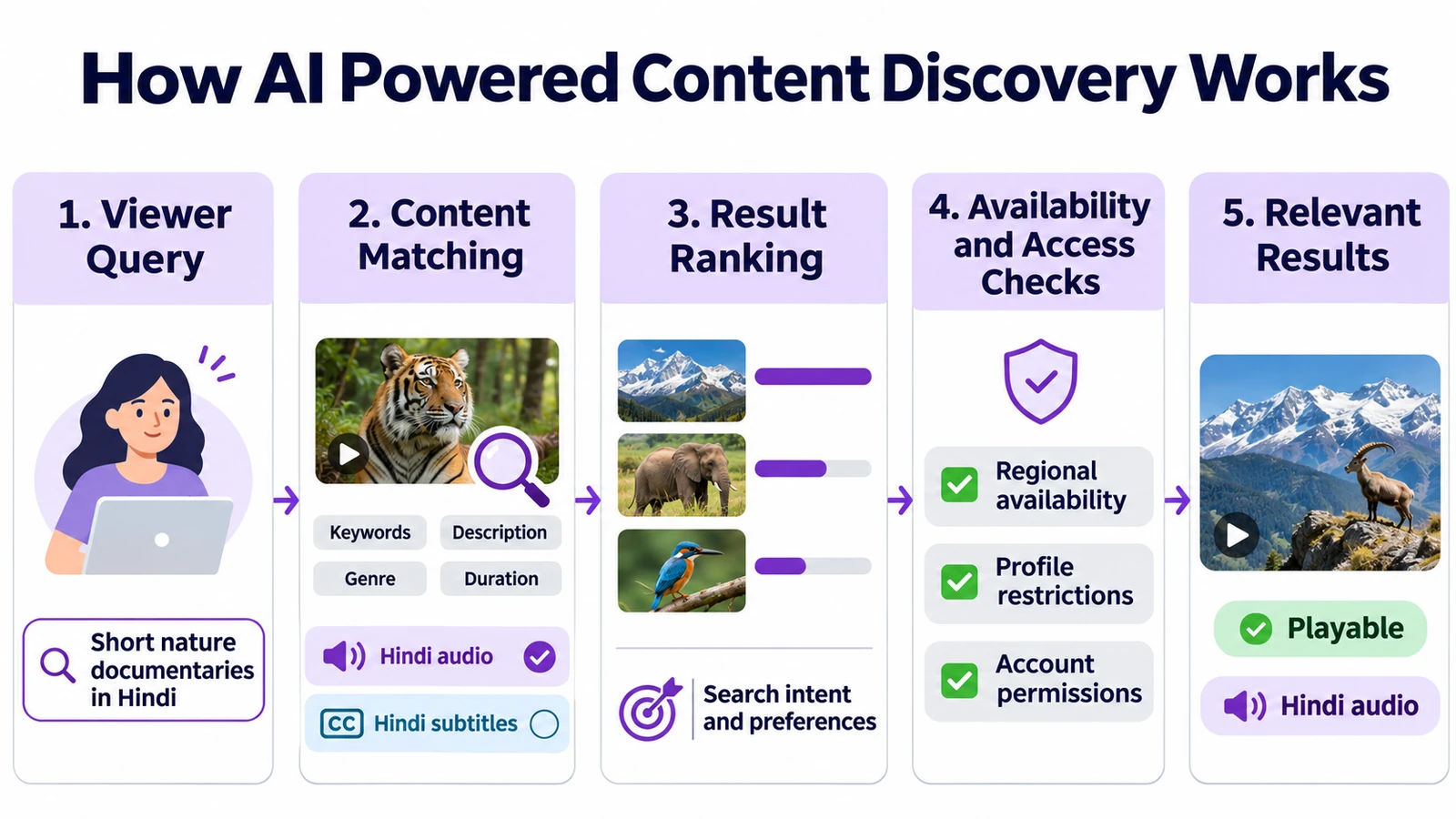
If someone searches for short nature documentaries, in Hindi, for example, there may be many results, however none will match exactly. An AI powered discovery feature will understand this query and return relevant content based on matching genre, duration and audio. In this way, content can be prioritised in order to help people easily find content which they can and wish to watch.
Quick Answer
Content discovery can be improved with AI. Search, recommendations and individualized navigation can be implemented. Information on title, along with search terms, viewed content, or language preference can be used. Within an OTT service it must also take into account what is available and accessible to play the content.
Is Content Discovery the Same as Recommendations?
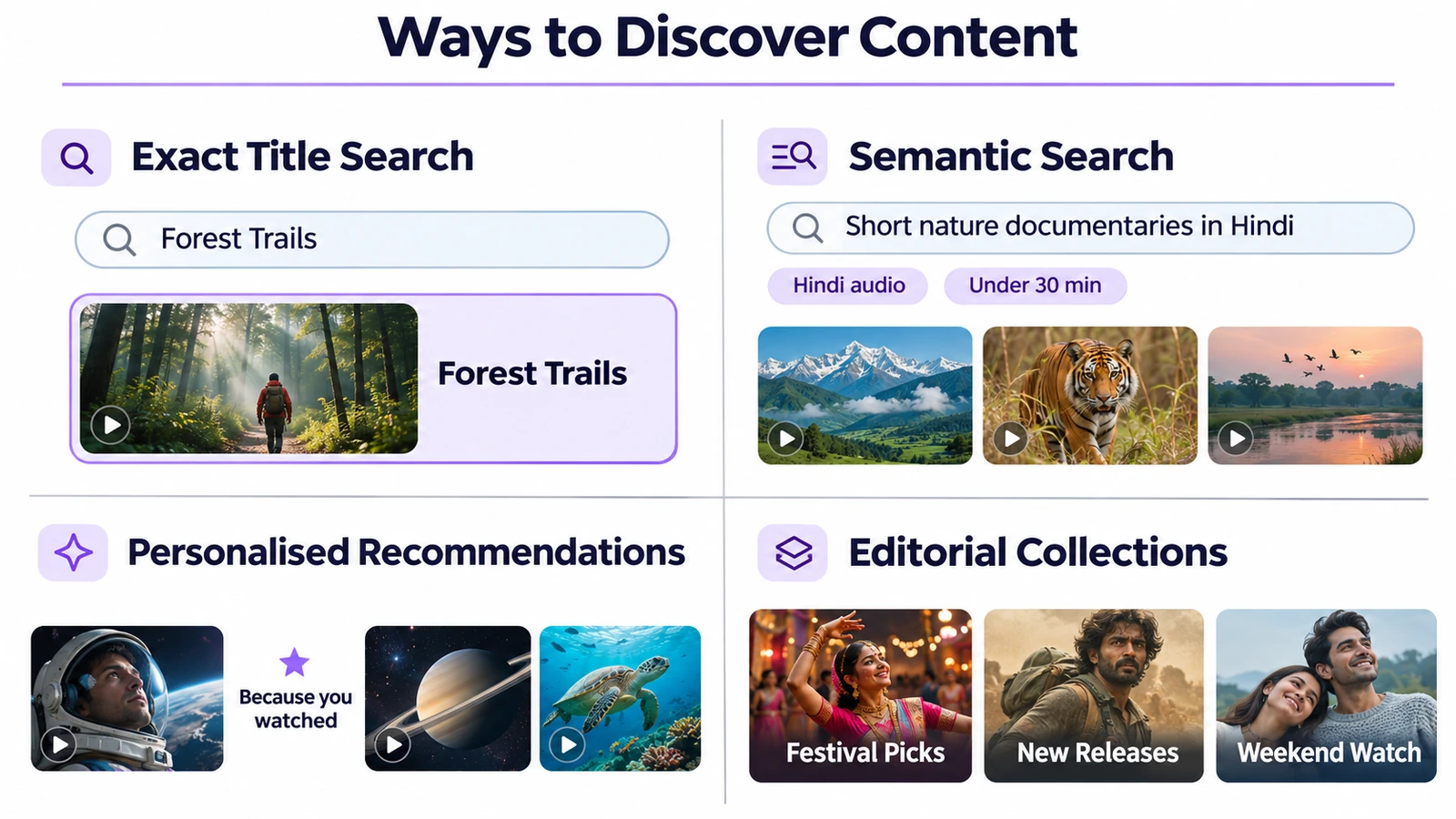
Recommendation systems can be implemented. Users may be able to select specific films to view (search). Alternatively, recommendation systems can be used to assist users in choosing a film. Editorial film lists could be used to identify an appropriate list of films for the festival. Or, simply highlight a recently released film. (No demand prediction models are used).
| Viewer intent | Discovery tool | What a good result looks like |
|---|---|---|
| Find a specific series | Exact title search | The correct series appears before similarly named titles. |
| Find something by topic, mood, or language | Semantic search and filters | Results match the meaning of the query and honor the selected filters. |
| Choose what to watch next | Personalized recommendations | Suggestions are relevant without repeating the same few titles. |
| Explore a curated selection | Editorial collections | The titles fit the theme, including newer ones with little viewing history. |
On an OTT platform, these tools can share a catalog without using the same ranking rules. Exact title search should prioritize the title the viewer typed, even when their watch history points to a different genre.
How Does AI Powered Content Discovery Work?
Titles may be shortlisted and ordered. Business logic can also affect results.
- Shortlisting and ordering: For search queries, matches may be based on title keywords and similarity of description to the query. For recommendations similarities between attributes may be considered, or similarities in watching habits of users.
- Ordering: When searching for “short nature documentaries in Hindi”, the search should prioritise matching by category, duration and audio language. However, if the user is simply watching on the Home page (with no search query) it may be more useful to use data from their viewing history, or a saved preference.
- Rules and ordering: Before displaying a title as playable, consider whether it is available in that region, any restrictions on it due to user profile and account permissions. If a user sees an option to rent or upgrade, it must be clear. Titles may also be ordered to promote new content, or to avoid multiple very similar content options.
Audio language and subtitles are separate fields. In this example, just because a documentary has subtitles in Hindi, does not mean it will be a good match for someone wanting to watch in Hindi audio.
What Information Does the System Need?
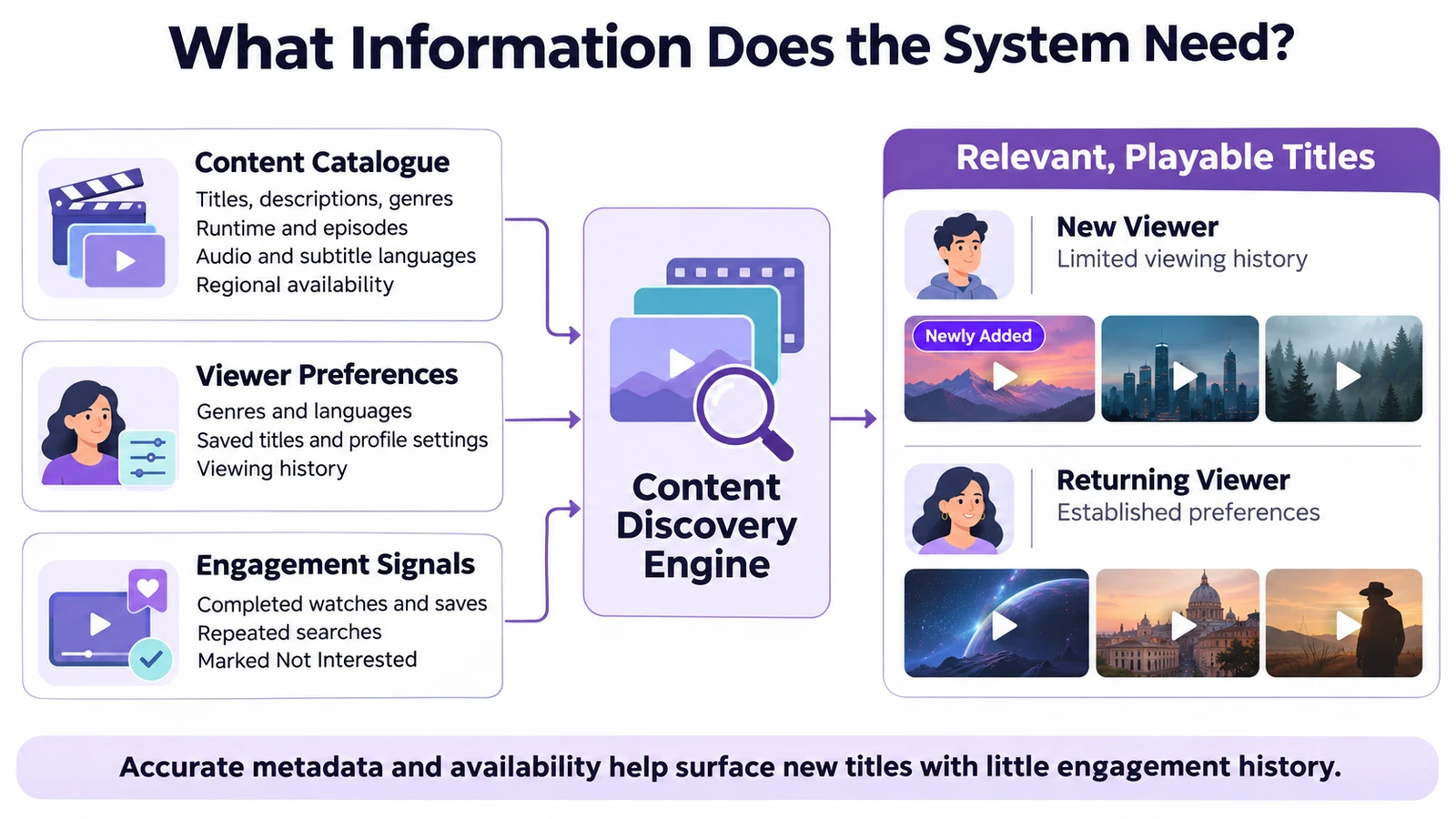
Start with the catalog. Reliable content management matters because a ranking model cannot consistently compensate for missing runtimes, incorrect episode numbers, or outdated availability. If the same movie arrives from two providers, check whether the records point to different editions or simply duplicate the same title.
User engagement can be used to improve rankings. However, depending on the engagement type, it may mean very different things. Completion, saving and explicitly not being interested in providing very different information. Watching for only a short period of time may provide little information. Users sharing accounts can mean that different viewing patterns are combined.
- New users: Show a selection of popular titles, or titles matching any selected preferences (language/genre).
- New content: Group content using metadata in order to suggest relevant content to users with little viewing history.
- Returning users: Allow users to manually fix recommendations and, where supported, reset recommendations for profiles.
How Can OTT Teams Tell Whether Discovery Is Improving?
For VOD libraries, Is there a clear change in behaviour by comparing to previous versions? If many elements within the app have changed at once then it may be difficult to understand what impact has been made.
- Search: What percentage of searches result in playable content? Which search terms give no results? How often do users search again?
- Good Experience: Look at the combination of engagement metrics with metrics that show good quality content was watched. For example, did users view content for longer than a few seconds? It may be that users clicked on content with appealing thumbnails, however they were not a good choice.
- Good Discovery: Is there a good variety of suitable content shown to users, or is there a limited variety of content?
Check by language, device and returning/new viewers. Even if performance is generally positive, it may be worse in some segments. If you are considering changing your ranking mechanism, it can be helpful to review specific examples. A poor result may be due to incorrect language identification, the rights having expired or that the title could not be launched.
Final Thoughts
Ensure that the recommendation algorithm is helping users make a decision. If you are seeing issues such as missing precise titles, incorrect filtering by language or repetition in recommendations; Firstly improve quality of content within the catalogue and availability. Then try changing the ordering of results and assess if it makes it easier to find appropriate and playable content. Ensure editorial decisions have been made in this process, particularly with newer content or smaller language catalogues. The best indicator of success is not simply increased clicks, but more users discovering content that they wish to continue watching.
For more on personalization and video streaming, explore OTT insights on LinkedIn.
Planning to launch or modernize an OTT platform?
StreamPlay helps media companies, sports leagues, and broadcasters launch branded OTT aggregator apps with CMS, monetization, discovery, and multi-device support.
Frequently Asked Questions
Is AI discovery equivalent to personalization?
AI discovery includes search, filtering and editorial, whereas personalization simply aims to tailor the results shown to users.
Can AI discovery be used for new users with no viewing history?
Yes. Recommendations can be made based on curation, popularity, or user self selected preferences.
Does AI discovery require generative AI?
No. Ranking, similarity and recommendations do not need generative video/ text within AI discovery.
What is semantic search?
Semantic search allows users to search for videos in a more flexible way based on meaning, rather than specific video titles.
Can AI discovery identify old content?
Yes. Old content matching a query/viewing preference can be identified.
What should we prioritize improving within OTT?
We should prioritize improving missing metadata and incorrect availability issues, as improving ranking will have little benefit if users cannot view the correct content.