OTT Platform vs Streaming App: What's the Difference?
Understand the difference between an OTT platform and a streaming app, including features, infrastructure, costs, and which solution your business needs.


Table of contents
What's the Difference?
When considering developing a video streaming service you will likely hear the terms OTT platform and streaming app being used. Whilst they may appear to be interchangeable they are different.
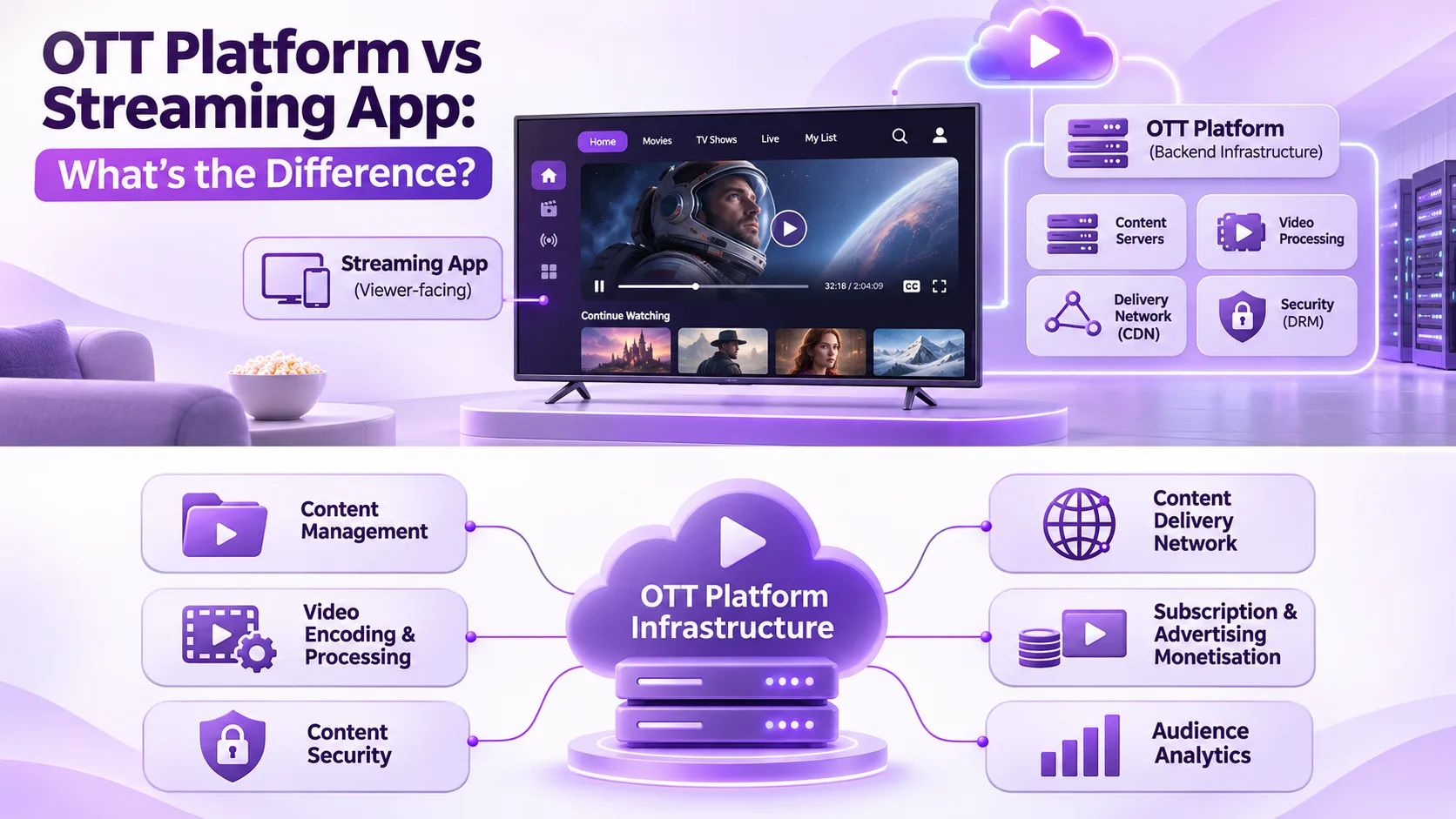
The streaming app refers to the front-end that your viewers will interact with to find and view your videos. The OTT platform refers to the technology and systems to help manage, deliver, monetise and secure your content.
By understanding the difference between an OTT platform and streaming app your business can ensure it invests in the correct technology, understand the development costs and avoid investing in an application that doesn’t have the required infrastructure behind it.
Quick Answer
The primary difference between an OTT platform and streaming application is a matter of functionality. Whereas an OTT platform will handle the video content, distribution, subscription, security and analytics, a streaming application will provide the user interface for viewing. Most commercial streaming platforms will require both of these functions to provide a full service for the viewer.
What Is an OTT Platform?
An Over The Top (OTT) platform refers to the technology that provides video over the internet.
It provides an interface between systems required to run your streaming service.
An OTT platform will generally have the following features:
- Content Management System (CMS): Manage your video library, descriptions and publishing times.
- Video processing: Content is encoded so it can be streamed via the internet.
- Content delivery: Video is delivered via servers and CDNs.
- Monetisation: Subscription, advertising or pay per view.
- Security: Manage permissions of content and digital rights.
- Analytics: Monitor quality of playback and audience behaviours.
For businesses launching branded entertainment services, white label OTT infrastructure can provide these connected capabilities without requiring every component to be developed independently.
An OTT platform is therefore responsible for much more than displaying videos on a screen.
What Is a Streaming App?
A streaming app is the front end solution that allows users to view digital video content.
These can be viewed using a smartphone, tablet, web browser, smart TV or connected streaming device.
Typically a Streaming Application will include:
- Browse content
- Playback functions
- User profiles
- Subscription & Account Functions
- Recommendations
- Subtitles & Language
When users open a movie application, navigate through the different categories and clicks ‘play’ they are interacting with the Streaming Application.
However, this application will generally require back end systems to fetch content, authenticate and stream the video.
A sleek UI will not be able to run the whole streaming business on its own.
Key Differences
Although the two components work together, their primary responsibilities are different.
| Feature | OTT platform | Streaming app |
|---|---|---|
| Main purpose | Manage and operate streaming infrastructure | Provide the viewing interface |
| Primary users | Content operators and administrators | Viewers and subscribers |
| Content management | Handles libraries and publishing | Displays available content |
| Video delivery | Manages processing and distribution | Requests and plays streams |
| Monetization | Controls payment and access rules | Presents payment options |
| Analytics | Collects operational and viewing data | Sends viewer activity events |
| Device support | Supports delivery across devices | Runs on individual device types |
The main distinction: An OTT platform operates the underlying service, while a streaming app provides access to that service.
The terminology can overlap in everyday marketing. Some companies call the complete consumer service an OTT platform, even though it includes both infrastructure and applications.
How Do an OTT Platform and Streaming App Work Together?
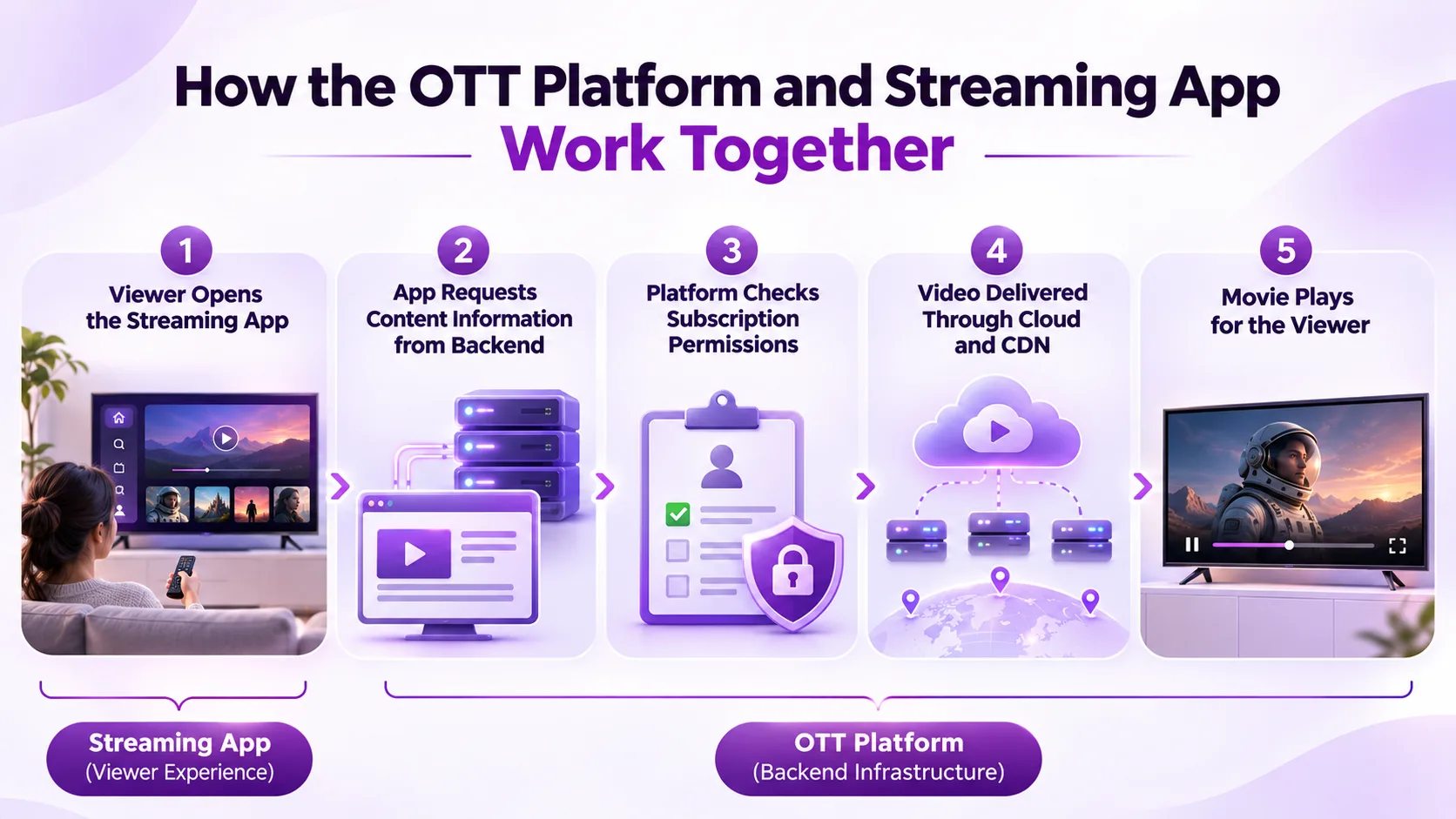
Let’s look at how a viewer would stream a movie using an entertainment app.
There are a few steps that happen to ensure your movie can be streamed.
1. Viewer opens the app
A list of categories, suggestions and available content is shown within the app.
2. Platform gets content information
Information about the content such as descriptions, imagery and availability is obtained from backend systems.
3. Platform checks permissions
If the movie is subscription only then the platform will check if the viewer has permission to view.
4. The video is streamed
Access to the pre prepared video is provided through the platform. A content delivery network can also help with distributing the video.
5. Video is played in the app
The video player will display the video. The video may be adjusted to different quality levels depending on the network connection.
For businesses comparing solutions, examining OTT platform features helps clarify which responsibilities belong to backend infrastructure and which are handled through viewer facing applications.
Can You Build a Streaming App Without an OTT Platform?
Yes. This can allow a basic streaming application to connect to multiple video hosting platforms, databases and playback systems.
This could work for businesses with simple content needs or dedicated development resources.
However, for commercial uses often more infrastructure will be required for:
- Managing licensed content
- Managing user access
- Automating payment
- Reliable video delivery
- Tracking playback performance
Developing these features individually will require integration and maintenance.
A streaming application shouldn’t be confused with an entire platform.
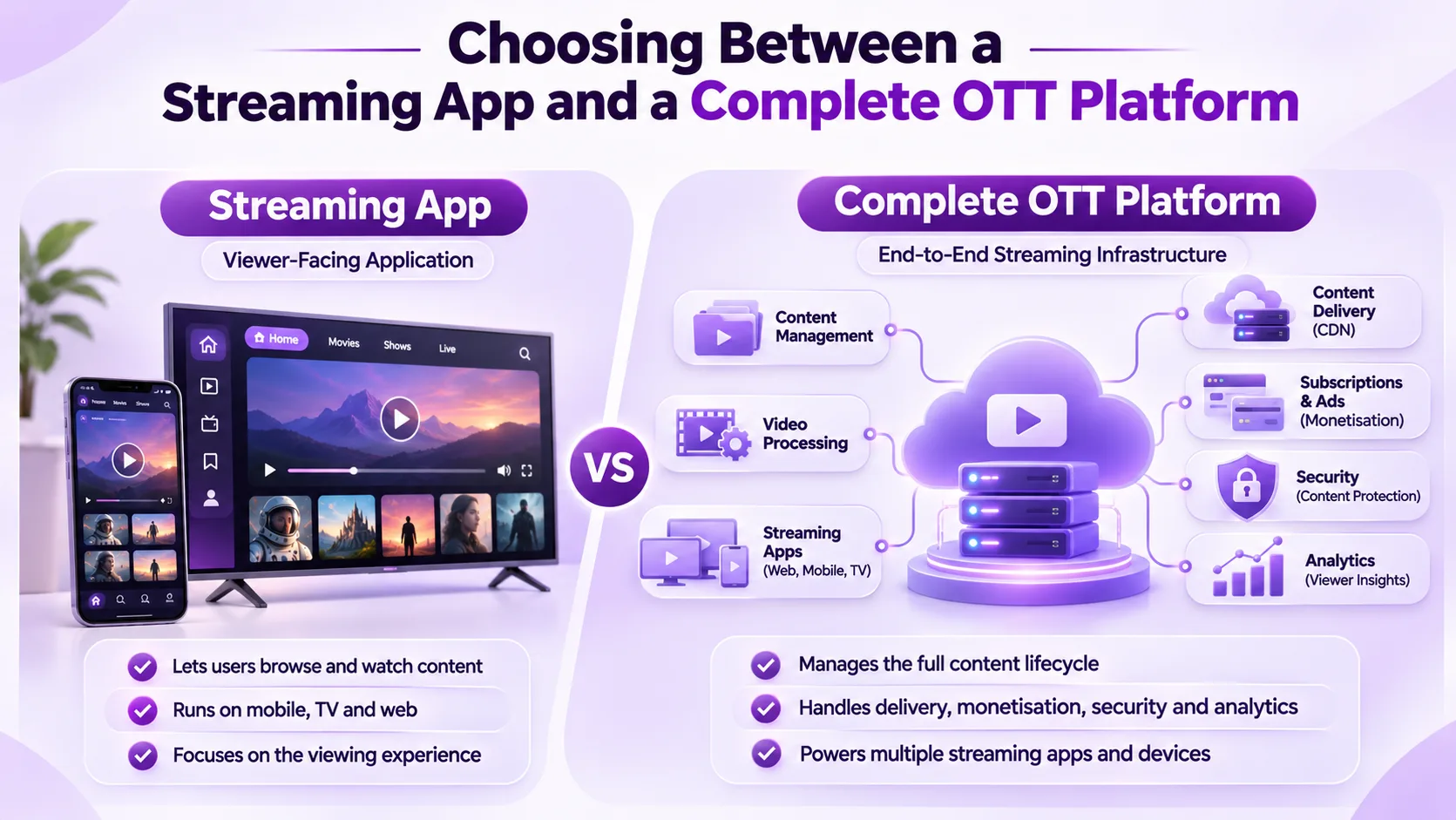
When Should a Business Choose a Complete OTT Platform?
What kind of solution will you need?
Streaming App
If your business has:
- Reliable backend systems
- Simple video requirements
- You have an application which does a fairly simple viewing process
- You have developers who can support the integration requirements
Complete OTT Platform
If you have:
- More than one content provider you have a license from
- Subscription, advertising or rental features needed
- Supports multiple devices
- Content security and geo blocking is a priority
- Centralised analytics and publishing tools
The aim is to find the right technology for your operation rather than just the biggest features available.
How Do Development Costs and Maintenance Differ?
There will be various costs involved between building and running your streaming app and OTT Platform.
Application Costs
Usually you will need to have the following:
- Design
- Navigation
- Video Player Integration
- Device Compatibility
- Updates
- OTT Platform Costs
- Content Management
- Encoding
- Storage
- CDN Bandwidth
- Payment System
- Security
- Tech Monitoring
Before you can even begin estimating your costs, ask yourself:
- Do we have any existing backend services?
- How many applications and device types do we need?
- Who will manage our content and subscription systems?
- How much streaming will we expect?
- What integrations require ongoing support?
A cheaper application to build may not save you money in the long run.
What Does This Difference Mean for a VOD Business?
Let’s imagine we have a movie distribution company setting up an online entertainment service.
They will need an application to allow users to browse their movies, view them, control the playback and interact with the service.
They’ll also need back end systems to manage licensing, metadata, video delivery, payment and content protection.
Video on demand management will help organise movies and episodic content for delivery on the appropriate devices.
This shows how you should consider the entire view process when choosing a solution for your business.
Final Thoughts
The difference between an OTT platform and a streaming app comes down to infrastructure and experience.
An OTT platform refers to the technology used to deliver, monetize, secure and manage your content. The streaming application enables your audience to easily access these services.
When considering building your own solution, you should consider how both will work together. By choosing the right technologies for your content, audience and resources you can create a more practical solution for streaming.
For more OTT technology insights and streaming industry updates, explore streaming industry insights on LinkedIn.
Planning to launch or modernize an OTT platform?
StreamPlay helps media companies, sports leagues, and broadcasters launch branded OTT aggregator apps with CMS, monetization, discovery, and multi-device support.
Frequently Asked Questions
What is the difference between an OTT platform and a streaming application?
An OTT platform is used to manage the streaming of content, whilst a streaming application is used by viewers to access content.
Is Netflix an OTT platform or streaming application?
Netflix is an OTT streaming service that contains the platform behind the scenes and also the applications that viewers will interact with on supported devices.
Can I use a streaming application without an OTT platform?
Yes, however you will still need services to host videos, deliver content and provide any additional functionality.
Are streaming applications included in OTT platforms?
Many OTT solutions will include or support branded streaming applications.
Which is more expensive, an OTT platform or streaming application?
The cost of an OTT platform or streaming application depends on your requirements for developing the service, what infrastructure is needed, what integrations are required, what devices are to be supported and what maintenance will be needed.
Do I require both an OTT platform and streaming application?
Most commercial streaming services will require an OTT platform to provide the streaming functionality along with a streaming application/website.