OTT Platform Development: Architecture, Steps & Costs
Explore OTT platform development, including technical architecture, app development, video delivery, APIs, security, costs, and essential testing steps.


Table of contents
Complete Guide
When building a streaming service there are numerous things to consider when creating the various systems required to manage your content, video, users, licensing and playback.
Creating an OTT platform will bring all these systems together to create a fully fledged streaming solution. You’ll need to think about how you want your systems to be set up, what technologies to use and make sure that the performance of your systems can scale with your growing audience.
This guide will walk you through creating your own OTT service by discussing the main technologies involved.
Quick Answer
An Over The Top (OTT) platform is an online video streaming service that contains various features such as Content Management, Video Transcoding, CDN, Streaming, Authentication and Monetization. It involves identifying your requirements, developing an architecture, integrating core components, building Applications and testing. Businesses can use bespoke development or pre-built infrastructure or a combination of both.
Where Should OTT Platform Development Begin?
Start by determining the technical requirements.
A streaming sports site will have different technical requirements than an educational video library. The former may need fast streaming and concurrent viewing, whilst the latter may require well organised content and tracking.
Before building your site think about what you want:
- What type of content? Live, Video On Demand or both.
- What platform? Web browser, mobile, smart TV or streaming device.
- How are you going to make money? Subscription, Advertising, Rentals or Pay Per View.
- What are the viewer requirements? Registration, Location and Content Permissions.
- What is the expected usage? Video Quality, Number of Concurrent Viewers and Library Size.
This will help you decide what architecture you need.
Businesses can evaluate existing OTT infrastructure alongside custom development to identify which technical components need to be built independently.
What Does an OTT Platform Architecture Look Like?
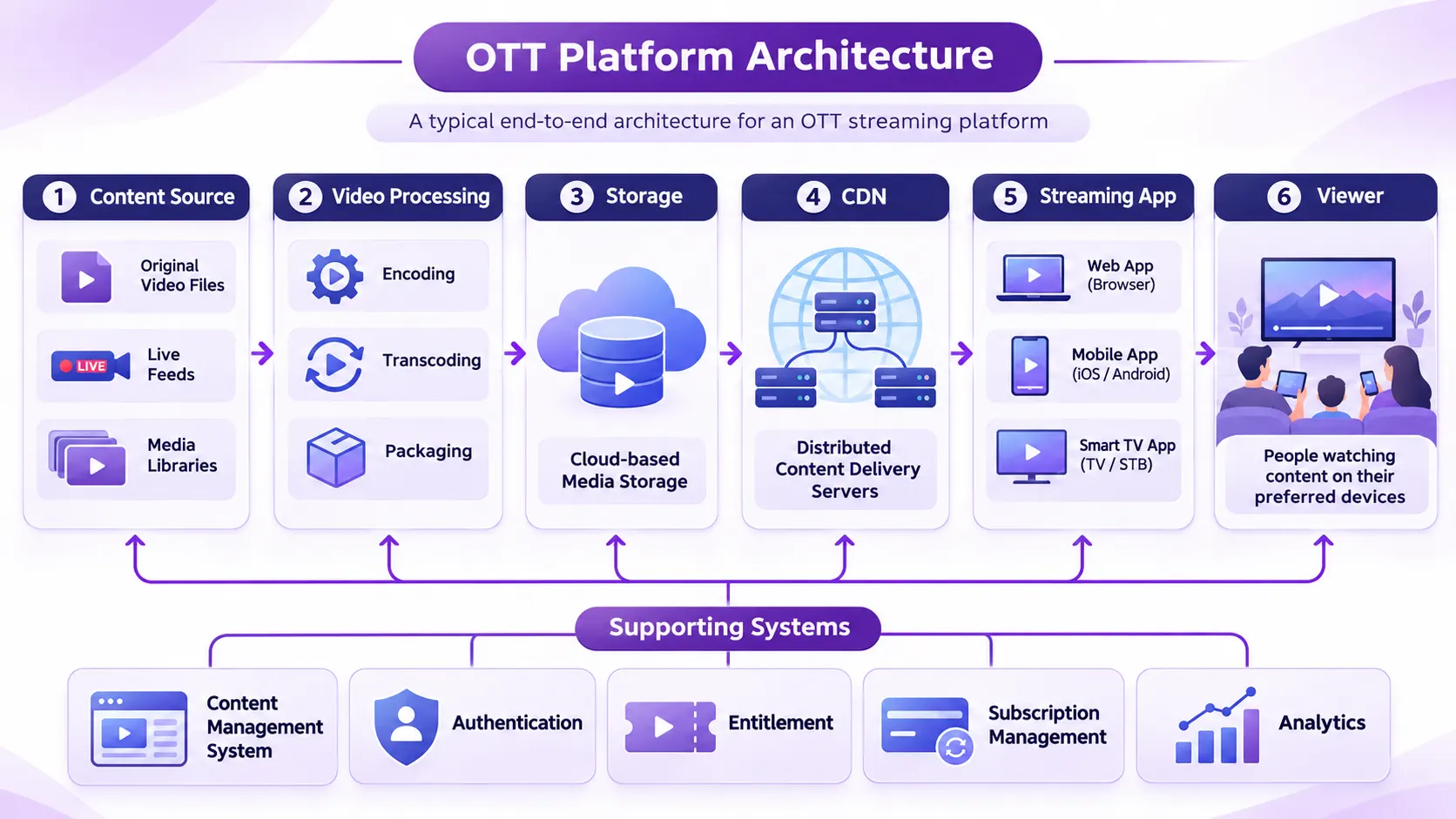
An OTT platform will have multiple interlinked systems.
A basic architecture may look like:
Content Source -> Video Processing -> Storage -> CDN -> Streaming App -> Viewer
With supporting systems providing authentication, subscription, analytics and admin.
Core Components
- Content Management System: This handles the management of videos, metadata, categorisation and publishing.
- Encoding & Transcoding: This ensures videos are delivered in the right format and quality.
- Content Delivery Network: Efficient delivery of streamed content.
- Authentication: Ensures users and their accounts are validated.
- Entitlement: Controls what content can be viewed by each user.
- Analytics: Captures data on how well videos are being played back and user interaction.
These can either be developed in house or with existing technology providers.
As long as the systems are communicating correctly then it should be fine.
Which Technologies Are Used in OTT Development?
Selecting a technology stack depends on platform complexity, supported devices, and available engineering resources.
| Development layer | Common technologies | Main purpose |
|---|---|---|
| Frontend | React, native mobile frameworks | Viewer interfaces |
| Backend | Node.js, Java, Python | APIs and business logic |
| Database | PostgreSQL, MongoDB | Accounts and metadata |
| Video delivery | HLS, MPEG DASH | Adaptive streaming |
| Infrastructure | Cloud storage, CDN | Media storage and distribution |
| Security | DRM, OAuth based authentication | Protected access |
This is just an example.
You can develop your application natively for connected television but develop using a web framework for browsers.
Choose your technology based on compatibility, ease of maintenance and team experience.
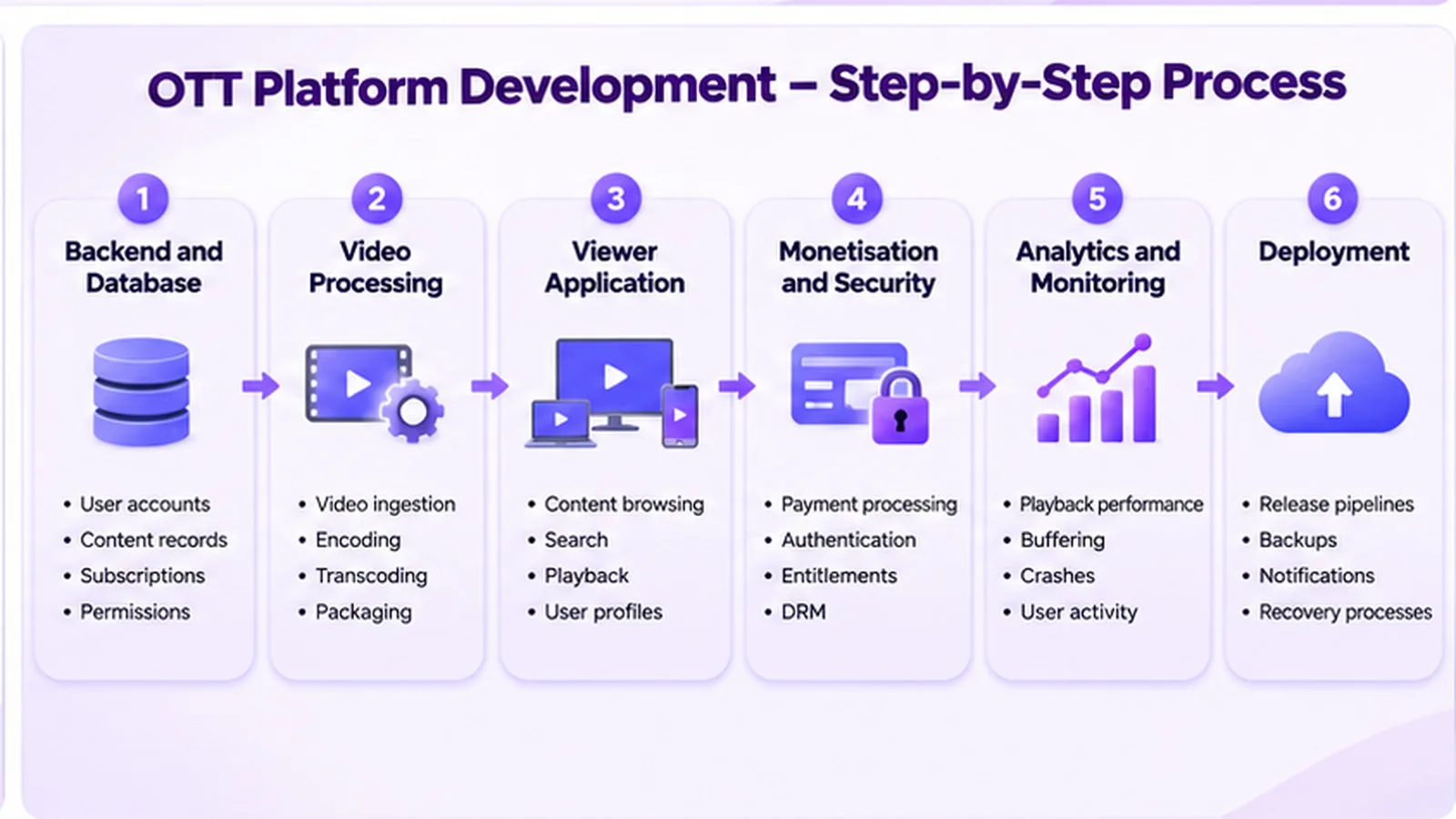
How Do You Develop an OTT Platform Step by Step?
Following an organised development process will help reduce any issues that may arise when integrating and ensure that your core features are functional.
1. Backend and Database
Design and develop your user services so that you can log users in and store content, subscriptions and permissions.
Before moving on, define how these systems will communicate with each other.
2. Video Processing
Set up your video ingestion, encoding, transcoding and packaging.
With adaptive bitrate streaming this can be streamed using compatible players, which will change the quality based on the network.
3. Viewer Application
Develop your navigation, searching, content pages, playback controls and user area.
Test your touch screen and TV remote controls.
4. Monetisation and Security
Add your payment processing, login, entitlements and DRM if required.
When a subscription payment is made successfully, ensure that the right permissions are set up.
5. Analytics and Monitoring
Monitor any issues with playback, buffering, crashing and key user events.
6. Deployment
Ensure that you have your deployment pipelines, back ups, notifications and recovery processes in place.
How Should APIs Connect OTT Platform Components?
APIs are used to share information between services. For example we might have an API for content which will allow us to retrieve a list of titles available. We might also have a subscription API that confirms if a user can view premium programming.
Key integrations required:
- Content catalogue and metadata APIs
- User login
- Payment and billing webhooks
- Playback authorisation
- Analytics and notifications
A common mistake when developing is not linking your payment confirmation and content. Ensuring events are handled correctly, with clear error messages and anti-duplication measures will help avoid this problem.
When assessing platform features, evaluate integration capabilities and backend compatibility alongside the viewer facing experience.
How Much Does OTT Platform Development Cost?
Development costs depend on application complexity, infrastructure choices, supported devices, and ongoing operational requirements.
There is no universal price for building a streaming platform.
The main cost drivers include:
| Cost area | What affects the expense |
|---|---|
| Application development | Platforms, interfaces, and customization |
| Backend development | APIs, databases, and integrations |
| Video infrastructure | Encoding, storage, and bandwidth |
| Security | DRM, authentication, and access controls |
| Maintenance | Monitoring, updates, and technical support |
Bandwidth and video processing can become significant recurring expenses as viewing increases.
Estimate operating costs using expected viewing hours, average bitrate, content storage, and anticipated traffic peaks.
How Do Live and On Demand Development Requirements Differ?
There are some similarities between live streaming and VOD solutions.
With a live stream you’re constantly receiving video data, with real-time processing of that data and low latency in delivering.
With on demand you will have prepared the content in advance.
Depending on your VOD solution you may need to have:
- Season/episode tracking.
- Large content organisation.
- Release scheduling.
- Multiple language tracking.
- Content availability & licensing.
It’s important to define any of these requirements upfront so you can plan how your database, processing and application will work.
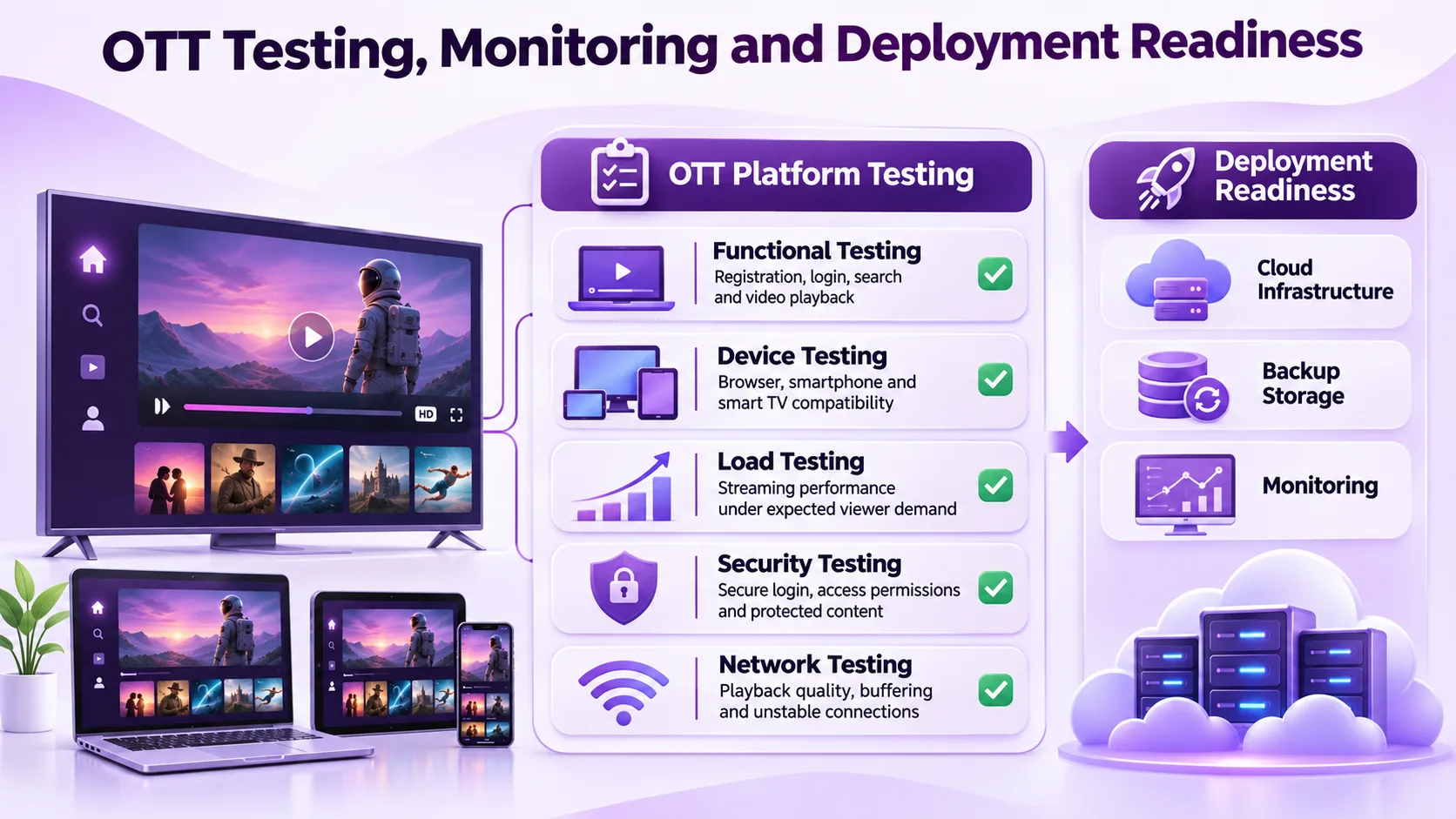
What Testing Is Essential Before Deployment?
Testing a development platform can sometimes cause unexpected issues when it goes live.
Testing the whole service:
- Functional Testing: Testing registering, logging in, searching and playing.
- Device Testing: Testing browsers, smart phones and TVs.
- Load Testing: Testing under expected load.
- Security Testing: Testing login, restrictions and protected content.
- Network Testing: Testing for buffering and playing issues on unstable networks.
Ensure you have the right responses for payment failure, subscription expiry and unavailable videos.
Automated testing will help show repeated issues but manual testing is required for navigation and playability.
Final Thoughts
Developing your OTT platform requires a balance between video infrastructure, back-end, application, security, monetisation.
The most effective way to start developing is to understand your requirements and have a solid tech foundation to support them.
Start with building the core workflows, ensuring they integrate well, perform under real world conditions and then build out the features based on your actual business requirements.
Having a strong architecture in place will make maintenance, debugging and development easier.
For more information about OTT development and streaming technology, explore OTT insights.
Planning to launch or modernize an OTT platform?
StreamPlay helps media companies, sports leagues, and broadcasters launch branded OTT aggregator apps with CMS, monetization, discovery, and multi-device support.
Frequently Asked Questions
What is OTT platform development?
The process of creating a system to manage, deliver, monetise and stream video content using the internet.
What technologies will be used?
Front-end framework, Back end API, Database, CDN, Adaptive Streaming & DRM.
How long would it take to create an OTT platform?
This really depends on how complex your application is. How many integrations you want to add, how many devices you want to support and how much testing you need to do.
Can you create an OTT platform without any coding?
Yes, White label services can be used to avoid any development.
What factors impact how much my OTT platform will cost?
Main factors will be developing your application, delivering the video content, integrating the back end systems, protecting the content, infrastructure costs and maintenance.
What is the key factor?
Having a reliable way to deliver, protect and integrate your back-end for your videos.