
FAST Streaming Statistics 2026: Key Industry Data
Explore FAST streaming statistics for 2026, including viewing growth, advertising trends, audience insights, and opportunities for streaming operators.


Table of contents
FAST Streaming Statistics 2026: Key Industry Data and Trends
Ad Supported Streaming Television or FAST is reimagining the way in which the audiences access online video content. Instead of traditional paid subscriptions, viewers have an option to enjoy the scheduled channels on a free ad supported platform.
For broadcasters, content owners, and streaming providers, FAST is an additional distribution avenue to showcase their existing content. However, beyond channel launching, operators need to deal with the management of the content, scheduling, advertising, metadata, and playback.
With that, here are the latest FAST streaming statistics that help understand the market landscape.
The latest survey conducted by Amagi and Ormax Media shows the increase in viewership across FAST platforms, growing advertising inventory, and the overall rise in India’s FAST audience. The statistics are insightful, and all should be considered with the research’s methodology and regional coverage in mind.
Quick Answer
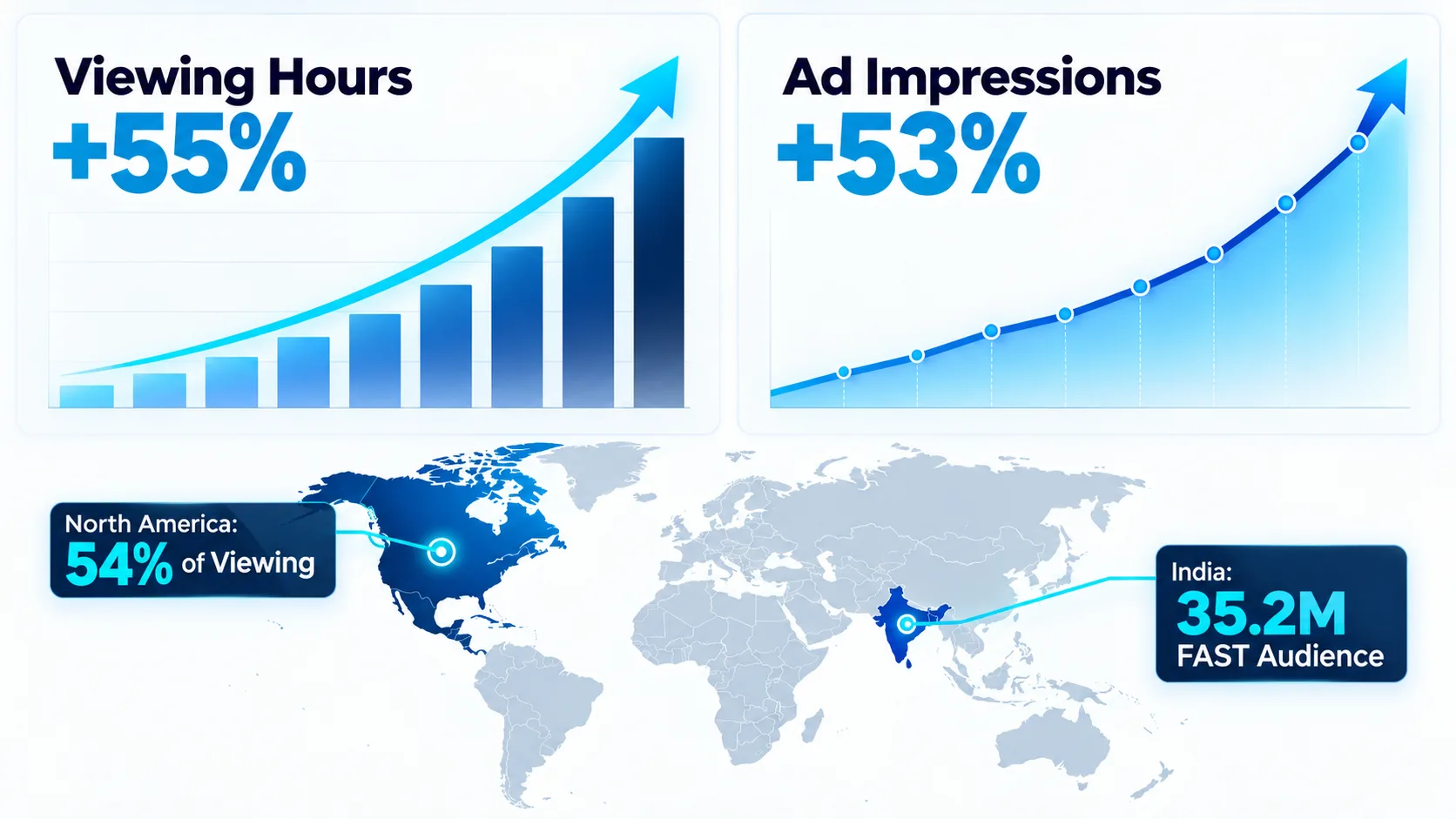
FAST (Free Ad Supported Streaming Television) is projected to be a significant distribution and monetization avenue for streaming companies in 2026. As per cited research in the article, Amagi announced a 55% year-over-year rise in viewing hours and 53% increase in advertising impressions across its tracked FAST channels. North America contributed to 54% of tracked viewing hours, whereas the FAST audience in India was estimated at 35.2 million. The analyzed statistics stress the importance of programming, advertisement operations, metadata management, and playback performance, as attention measurement, ad fill, revenue, and technical quality are vital for most streaming operators to benefit from the growing interest in FAST.
FAST Streaming Statistics at a Glance
The following figures highlight important developments in the FAST market during 2026.
| Metric | Reported finding |
|---|---|
| Global FAST viewing hours | Increased 55% year over year in Amagi's tracked dataset |
| FAST advertising impressions | Increased 53% year over year in the same dataset |
| North American share of viewing hours | 54% of the tracked global total |
| North American share of ad impressions | 74% of the tracked global total |
| India's estimated FAST audience | 35.2 million people in 2026, according to Ormax Media |
Amagi's June 2026 AIRTIME Report compares the period April 1 to June 15, 2026 with the same period in 2025 and covers approximately 6,500 FAST channel deliveries on its platform. The India audience estimate is derived from the separate Ormax OTT Audience Report 2026.
These statistics refer to different datasets. They should not be aggregated to derive an overall estimate of the worldwide FAST market or to imply growth rates for all streaming services.
1. FAST Viewing Hours Increased by 55%
One of the most eye-catching figures in Amagi’s June 2026 report is the 55% year over year increase in FAST viewing hours across the channels it tracks.
While hours of viewing are an obvious metric for measuring consumption, the metric goes beyond simply launching channels and hoping that people will visit them.
Some channels will see a rise in viewing hours due to a popular film series, a reliable news magazine, or a particular type of programming block, whereas others may see little or no increase. It’s always worth remembering that these are distinct channels with significantly varying programming and audiences.
For operators, it will be essential to look at a channel level and see what attracts viewers to the channels and what keeps them engaged. In addition, it will be interesting to see if certain programs have a better impact on the metric than others and whether they attract more viewers during specific times.
2. FAST Advertising Impressions Grew by 53%
Amagi also recorded an increase in advertising impressions by 53% YoY for its tracked FAST channel deliveries.
Advertising impressions are the number of times advertisements appear or are delivered according to the relevant metric system, and represent an essential advertising metric. They are, however, not directly related to overall advertising revenue.
There are several factors that contribute to the total advertising revenue that FAST channels can record. These include:
- Advertising inventory available for sale
- Ad fill rates and the number of delivered impressions
- Advertiser demand and campaign pricing
- The audience location and demographics
- Ad placement, delivery reliability, and measurement
- Agreements with advertising partners and distributors
For example, a channel that experiences an increase in time spent watching but sees little change in revenue could be affected by inventory availability, lower fill rates, decreased campaign prices, or a combination of these factors. The channel’s audience may not appeal to advertisers, or the channel’s distribution may put it in competition with other channels that offer similar programming.
That is why streaming operators should evaluate both their viewership and monetization. Increased impressions open the door to more advertising revenue, but operators need to have efficient advertising operations in order to profit from them.
3. North America Accounts for a Large Share of FAST Viewing and Advertising
Based on Amagi’s report for June 2026, the United States and Canada represent 54% of global FAST viewing hours and 74% of advertising impressions.
Although the difference between the two is substantial, it apparently means that North America is disproportionately skewed toward the benefit of advertising impressions for the tracked channels.
However, this fact, on its own, is not sufficient to assume that each channel group in North America is likely to be, on average, more profitable due to a higher percentage of impressions.
The revenue from advertising is affected by many factors: the cost of inventory, the appeal of content, the target audience, and others.
Thus, if a company wants to distribute its product internationally, it needs to analyze the market on a regional level. If the channel group turns out to be more profitable in one region than in another, the company may want to consider varying its content, partners, languages, and other factors in different regions. The report can help companies identify viewing patterns, analyze how different channels sell their advertising inventory in local markets, and determine whether a channel’s popularity translates into higher yields and profits across borders.
4. India's FAST Audience Reached an Estimated 35.2 Million
India is the other marketplace to keep in mind for now as cord cutting and ad supported streaming progress.
According to the Ormax OTT Audience Report 2026, the FAST audience in India is projected to reach 35.2 million subscribers. India’s overall OTT audience, simultaneously measured, is anticipated to comprise 664.9 million residents.
It is crucial to realise that these are two distinct figures characterizing the audience distribution. Whereas the overall number represents the video viewership in the past month, the FAST specific projection refers to the ad supported channels only. This particular nuance should not be ignored when comparing the figures and analyzing the underlying trends.
In essence, the attention span of the Indian audiences for the FAST channels can be seen as a vital sign for the region’s content providers and distributors. For example, the given metric may suggest that a particular distributor should master the opportunities of ad supported TV programming and expand their OTT portfolio with the complimentary subscription and on demand services.
However, it is noteworthy that the overall appeal of particular channels is not correlated directly with their likelihood of success. In other words, a high viewership rating does not guarantee a sustainable customer base for any given channel operator. Thus, the emergence of a competitive ad-based OTT channel requires a careful analysis of the targeted languages, programmes, subtitling, advertising potentials, devices, and distribution contracts at the entry level.
5. FAST and Video-on-Demand Support Different Viewing Habits
Both FAST and video-on-demand provide digital video but it is provided in different ways.
FAST has a scheduled channel format whereas VOD lets the viewer pick the specific movie or episode they want to watch.
A streaming service can offer both types of platforms without them contradicting each other.
For example, a distributor of documentaries can provide their films individually under the VOD section while also providing a FAST channel that will air nature, history and some weekend themed episodes.
Having the documentaries under the catalog gives the consumer what they're looking for specifically whereas the FAST channel serves another audience.
The main issue would be the licensing of the content. Having bought the rights to air an episode does not give the broadcaster permission to include it under the channel's schedule.
Businesses evaluating an OTT platform should consider their content catalogue, licensing agreements, audience preferences, and operational requirements before selecting a distribution model.

6. Metadata and Channel Operations Can Influence Performance
Audience growth is only one aspect of a FAST service. Every channel has an operational workflow that ensures that the programmes are properly prepared, organised, scheduled, available, and delivered.
Amagi's June 2026 AIRTIME Report highlighted metadata management as a significant challenge for media businesses.
It contains information attached to a programme, including its name, description, genre, language, episode details, artwork, and availability. It may be challenging to curate and manage a channel if this data is inaccurate or inconsistent. For instance, a distributor might have hundreds of programmes but provide inconsistent details about the shows or have incorrectly formatted artwork. This data would need to be massaged and formatted before publishing the titles on multiple streaming services.
In addition, FAST operators must manage:
- Scheduling and playlist changes,
- Content availability and licensing,
- Programme descriptions, categories, and artwork,
- Advertising breaks and delivery,
- Playback monitoring and troubleshooting,
- And content replacement in the event of a channel lockout or other programme transitions.
As channels grow and carry more shows and reach a greater number of viewers, the complexity of these tasks increases.
When assessing StreamPlay's FAST channel capabilities, streaming businesses can explore how scheduled channels fit into a broader content distribution setup. The right workflow should match the operator's actual requirements rather than add unnecessary complexity.
7. FAST Operators Should Track More Than Viewing Hours
Industry reports are helpful, but the streaming company will benefit more from data concerning its performance.
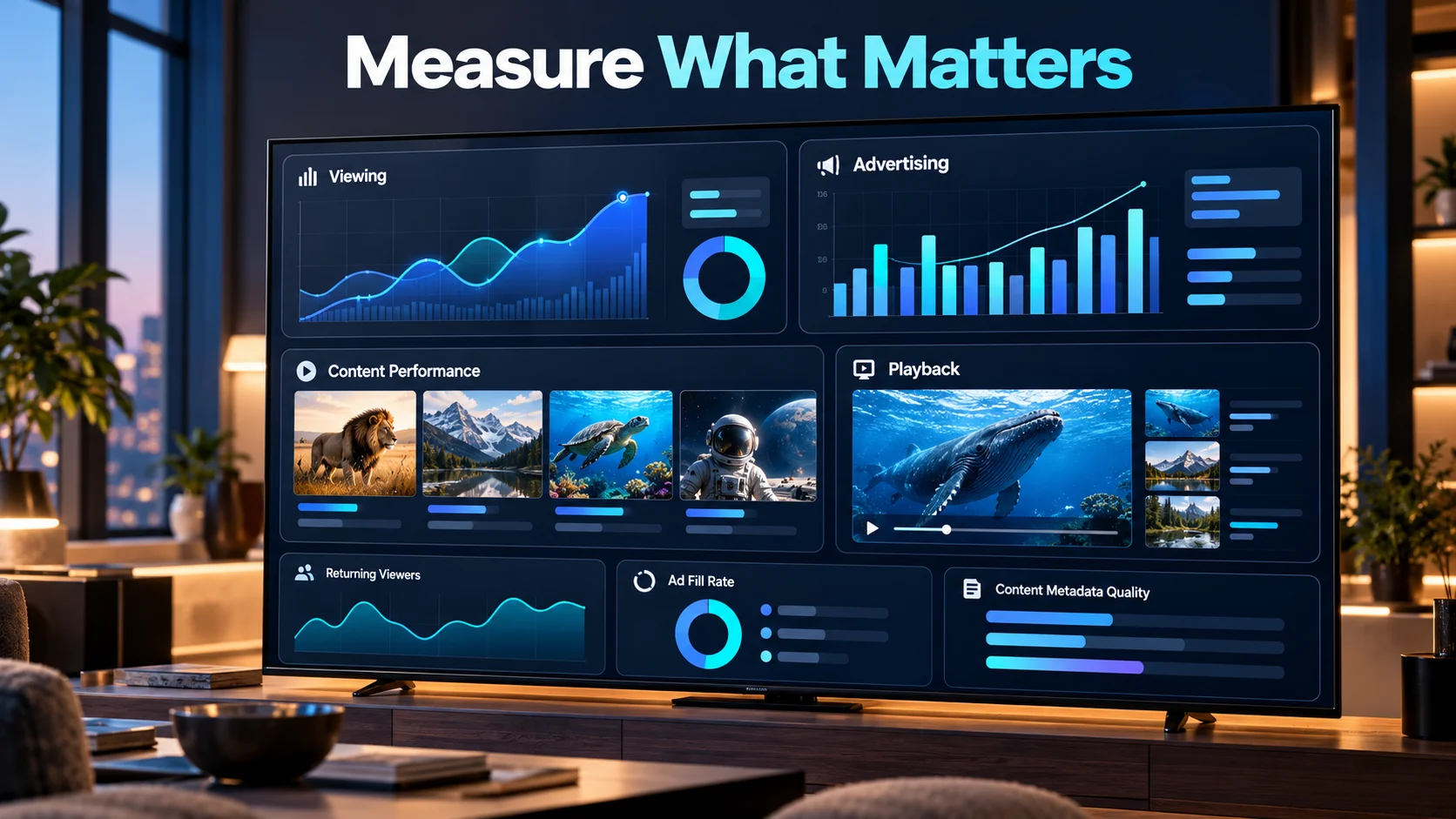
The realistic FAST dashboard needs to include audience engagement, advertising data, content analysis, and technical performance.
Important metrics include :
- Total viewing hours: Measures the amount of time audiences spend watching.
- Average viewing time: Helps show whether viewers stay with the channel.
- Returning viewers: Indicates whether audiences come back regularly.
- Programme performance: Identifies popular titles, genres, and time slots.
- Advertising impressions: Tracks delivered advertising activity.
- Ad fill rate: Shows how much eligible advertising inventory is filled.
- Advertising revenue: Measures the commercial return from monetized viewing.
- Playback failures: Highlights technical issues that interrupt viewing.
- Metadata completeness: Helps identify missing or inconsistent programme information.
Device and regional performance: Shows how results vary across audiences and markets.
These metrics are most useful when they are considered together.
For example, the channel could be seeing increased viewing hours, but the audience retention score could be low. It would indicate that the team has to research programme transitions, scheduling issues, or playback problems. On the other hand, if the channel’s viewing hours are up, but the revenue from advertising is not, it may need to research fill rates, advertiser demand, and inventory availability.
The point of analysing this data is not to accumulate more information but understand how it qualifies the channel and what alterations could improve its performance.
What the FAST Streaming Statistics Mean for Businesses in 2026
Interpretation of the 2026 research findings
The available research points to ongoing activity in the FAST sector. Amagi reported significant YoY growth on metrics like viewing hours and ad impressions across its channels, while Ormax Media estimated India’s FAST audience at 35.2 million.
Together, these findings provide valuable evidence of the engagement and advertising activity in the field. However, they do not identify the growth rate that will be common to the entire global market, and do not guarantee identical results for all operators.
For streaming businesses, several practical considerations stand out:
- Choose programming carefully. Match the channel's content and schedule to the audience it is intended to serve.
- Understand monetization. Review impressions, fill rates, advertising revenue, and campaign demand together.
- Prepare content for distribution. Maintain accurate metadata, artwork, rights information, and programme schedules.
- Evaluate each market separately. Language, viewing preferences, and advertiser demand can differ considerably by region.
- Monitor performance continuously. Use channel level analytics to identify problems and test improvements.
FAST can create another distribution and monetization opportunity for content owners. Its commercial value, however, depends on the quality of the programming, the audience it reaches, and the systems used to manage and deliver the service.
Final Thoughts
The FAST streaming statistics for 2026 present a compelling view of the growth in both viewership and ad distribution for the channels covered by Amagi’s latest report. However, the findings from Ormax Media’s research provide a valuable insight into the rising FAST audience in India.
For operators, the relevant question is not only about the growth of this market but also if a specific channel can attract the right viewers, offer an engaging experience, and provide advertisers with valuable inventory.
To begin with, it is essential to consider what content rights, audience, distribution, and monetization strategies the channel will use. Next, an operator should create the most suitable operational workflow that will support scheduling, metadata management, reliable playback, and performance analytics.
This approach will help operators and streaming companies enter the fray more prepared for the opportunities and realities of the FAST platform in 2026 and beyond.
For more company updates and insights into OTT technology and streaming operations, follow StreamPlay on LinkedIn.
Planning to launch or modernize an OTT platform?
StreamPlay helps media companies, sports leagues, and broadcasters launch branded OTT aggregator apps with CMS, monetization, discovery, and multi-device support.
Frequently Asked Questions
What are the leading FAST streaming statistics for 2026?
Amagi reported that viewing hours on their tracked FAST channels grew by 55%, with ad impressions rising by 53% in 2026.
How much is FAST streaming growing in 2026?
FAST growth is regional, and it depends on the platform providers. Overall, Amagi’s 2026 report suggests that the adoption of FAST TV is gaining significant momentum globally.
How big is the FAST audience in India?
According to Ormax Media’s FAST TV 2026 report, there are 35.2 million FAST TV viewers in India.
How does FAST generate revenues?
FAST generates revenues from advertisers who air their commercials during the scheduled programming in exchange for advertisements.
What distinguishes FAST from Video on Demand (VOD)?
FAST provides programmers with linear channels while VOD services offer à la carte catalogs.
What are the critical performance indicators (KPIs) for FAST channel operators?
The key performance indicators (KPIs) include viewership hours, audience retention, ad impressions, revenue, playback failure rate, and metadata accuracy.