The Future of OTT: Will Everything Merge Into One Super Platform?
Explore whether OTT fragmentation will give way to a single super platform. Learn what drives consolidation, what stands in the way, and how StreamPlay is leading the way.

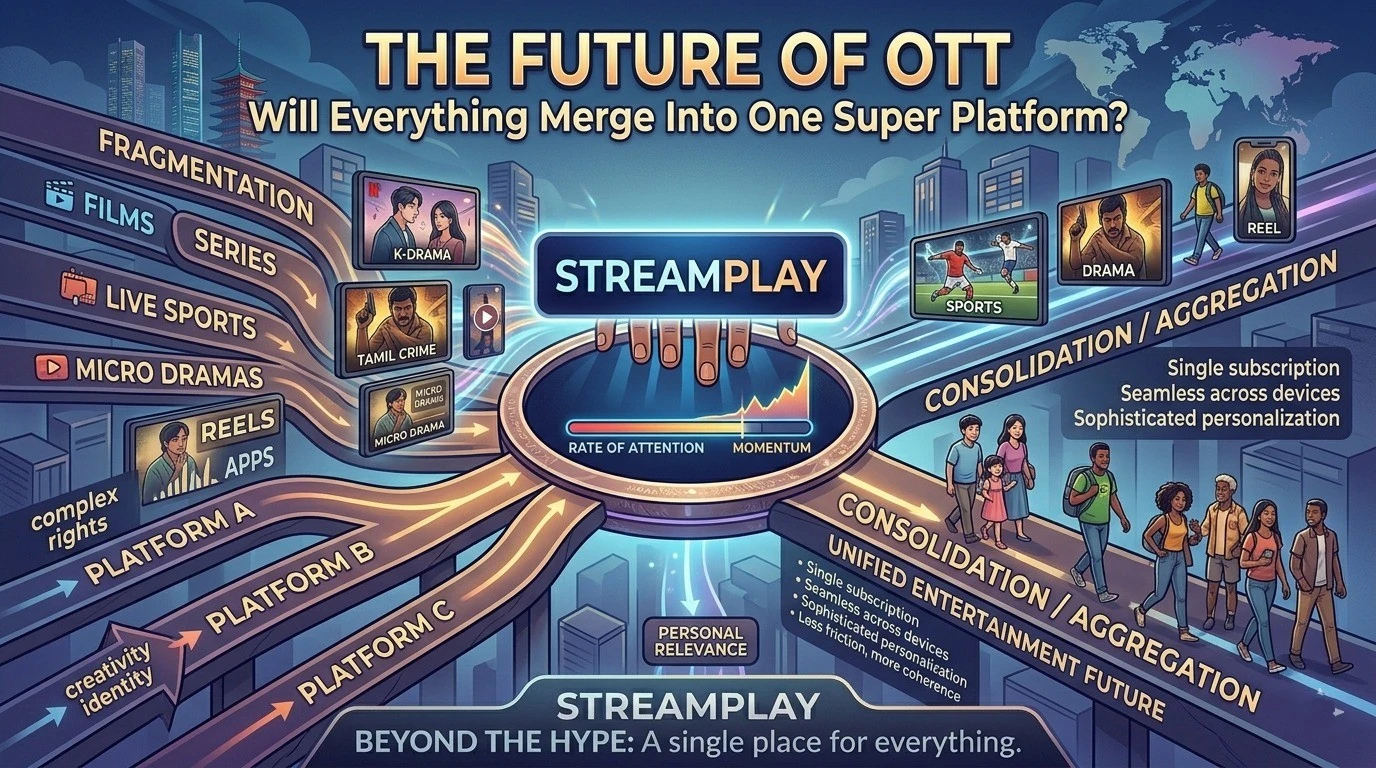
Table of contents
What actually happened was rather different. The streaming revolution fragmented the entertainment landscape into dozens of competing platforms, each holding exclusive rights to specific content and requiring its own subscription. In many ways, streaming recreated the very problem it was supposed to solve — except viewers were now managing multiple apps instead of multiple cable packages.
So is a correction coming? Will consolidation eventually produce the single super platform the original streaming dream implied? This piece examines where the OTT industry is heading — and what it means for viewers, creators, and platforms like StreamPlay that are already building toward a more unified entertainment future.
Why This Matters
Here is why the super platform debate matters right now:
Cumulative subscription costs across multiple platforms now rival what cable television once charged
Viewer fatigue with managing multiple apps is driving measurable increases in churn
Smaller platforms are already merging or shutting down under financial pressure
Content exclusivity is weakening as the economics of streaming have shifted dramatically
Platforms offering broader libraries across formats are gaining structural advantages over narrow competitors
Core Concepts: Understanding OTT Consolidation
How Fragmentation Happened in the First Place
Each platform differentiated itself through exclusive content, using titles only available in one place to drive subscriber acquisition. This exclusivity worked well enough during the growth phase, but it came at a cost. Viewers signed up to multiple services and watched their cumulative spending creep back toward what cable had once charged. The convenience streaming promised was eroded by the complexity fragmentation introduced.
Explore StreamPlay's unified content library — movies, series, live sports, micro-dramas, and reels — all in one place without the fragmentation that defines the broader market.
Key Points
Exclusive content drove subscriber acquisition but raised costs for viewers overall
Multiple interfaces and billing relationships created genuine cognitive burden for viewers
The original promise of simplicity was partially lost to platform proliferation
Example / Use Case
A viewer following three different drama series in 2024 finds each one on a different platform. They maintain three simultaneous subscriptions, navigate three separate interfaces, and face three separate renewal decisions each month — a situation structurally identical to the cable bundle streaming was meant to replace.
The Economic Pressures Driving Consolidation
Subscriber growth has plateaued in mature markets, forcing platforms to compete for a fixed pool of viewers rather than expanding the overall audience. In this environment, scale becomes decisive. Larger platforms with broader libraries and greater revenue have structural advantages that smaller competitors simply cannot match over time. Several platforms have already merged, been acquired, or shut down entirely, unable to sustain the content investment required to remain competitive.
Viewer behaviour is accelerating this process. Subscribers who once maintained four or five simultaneous services are rationalising down to two or three, rotating between platforms rather than sustaining them all. This pattern rewards genuine breadth — across movies, series, live sports, and short-form content — and punishes narrow catalogues decisively.
Key Points
Scale advantages favour larger platforms in an era of subscriber plateau
Viewer rationalisation is accelerating consolidation by reducing tolerance for thin catalogues
The content arms race has proven unsustainable for platforms without sufficient subscriber bases
Example / Use Case
A mid-sized streaming platform with strong original dramas but no live sports or short-form content finds its subscriber base rotating in and out seasonally. Viewers subscribe for a specific series, finish it, and cancel — a pattern that makes sustained profitability impossible without a broader content offering to anchor retention.
What a Super Platform Would Actually Require
Beyond content, it would require sophisticated personalisation that understands each viewer's preferences across all format types and surfaces the right content at the right moment. A viewer wanting a long drama on Friday evening and a short micro-drama during a Tuesday lunch break should encounter a platform that already anticipates this. StreamPlay's personalised discovery experience is built around exactly this principle — learning preferences across content types rather than within a single category.
Key Points
Personalisation must work across content types, not just within one genre or format
Seamless device experience with consistent watch history and recommendations is essential
A single subscription must feel genuinely fair relative to the breadth it delivers
Example / Use Case
A family of four uses one platform together. One member follows cricket live, another watches prestige drama series, a third uses short micro-dramas during commutes, and the youngest watches animated films on weekends. A true super platform serves all four within one subscription and one interface without compromise.
Key Benefits of a Unified Streaming Platform
For viewers:
Single interface eliminating the cognitive burden of remembering which show lives where
Personalisation that learns preferences across all content types simultaneously
Genuine content breadth that removes the need to rotate between platforms seasonally
For the streaming industry:
Healthier unit economics from subscribers who stay rather than rotate
More effective personalisation data from full-spectrum viewing behaviour
Reduced subscriber acquisition costs as breadth replaces exclusivity as the retention driver
Common Mistakes in the Consolidation Debate
Underestimating how complex content rights and territorial restrictions make true consolidation
Conflating aggregation (unified interface) with merger (unified ownership)
Expecting consolidation to happen quickly when regulatory and commercial obstacles are significant
Overlooking platforms already building unified experiences from the ground up rather than merging legacy systems
Future Trends in OTT Platform Development
Artificial intelligence will play a central role in making aggregated or unified platforms genuinely useful rather than simply large. Next-generation recommendation systems will understand viewing context — time of day, device, session length, mood signals — and surface content that matches not just long-term taste preferences but immediate viewing intent. StreamPlay's evolving sports and entertainment discovery already reflects this direction, treating personalisation as a platform-wide capability rather than a feature applied to a single content category.
Conclusion
StreamPlay is not waiting for the industry to consolidate around it. It is building the unified platform content category by content category, with the viewer experience as the organising principle from day one. Start your StreamPlay journey today and experience what a genuinely unified entertainment platform feels like.
Planning to launch or modernize an OTT platform?
StreamPlay helps media companies, sports leagues, and broadcasters launch branded OTT aggregator apps with CMS, monetization, discovery, and multi-device support.
Frequently Asked Questions
Will all streaming platforms eventually merge into one?
Full merger is unlikely in the near term due to content rights, regulatory scrutiny, and commercial incentives for exclusivity. However, aggregation models and platforms built for breadth are already moving the industry toward a more unified viewer experience.
Why did streaming become so fragmented in the first place?
Every major content owner recognised the value of owning the direct viewer relationship and launched its own platform. Exclusive content drove subscriber acquisition, but the cumulative effect recreated the complexity that streaming was originally meant to eliminate.
What is the difference between aggregation and a true super platform?
Aggregation brings multiple services into one interface without common ownership. A true super platform owns or licenses the content across all categories. Aggregation is more achievable near-term; a fully owned super platform faces greater legal and commercial barriers.
How does viewer fatigue affect OTT consolidation?
Subscribers rationalising down from four or five services to two or three accelerates consolidation pressure. Platforms with thin catalogues lose subscribers to rotation, while those with genuine breadth across formats retain viewers more effectively.
How does StreamPlay approach the super platform challenge?
StreamPlay has been built from the ground up to serve the full spectrum of viewing occasions — movies, series, live sports, micro-dramas, and reels — within one unified interface and one subscription, treating breadth and personalisation as core design principles rather than later additions.